UNTP Registers — Overview
The UNTP registers are a set of public, UN-maintained directories that catalogue the trusted technical building blocks every UNTP implementation needs: the software platforms, conformity schemes, credential extensions, and identifier services. They exist so your community can build on what's already trusted, not start from scratch.
The roots that hold the tree up
UNTP governance is structured as a tree.
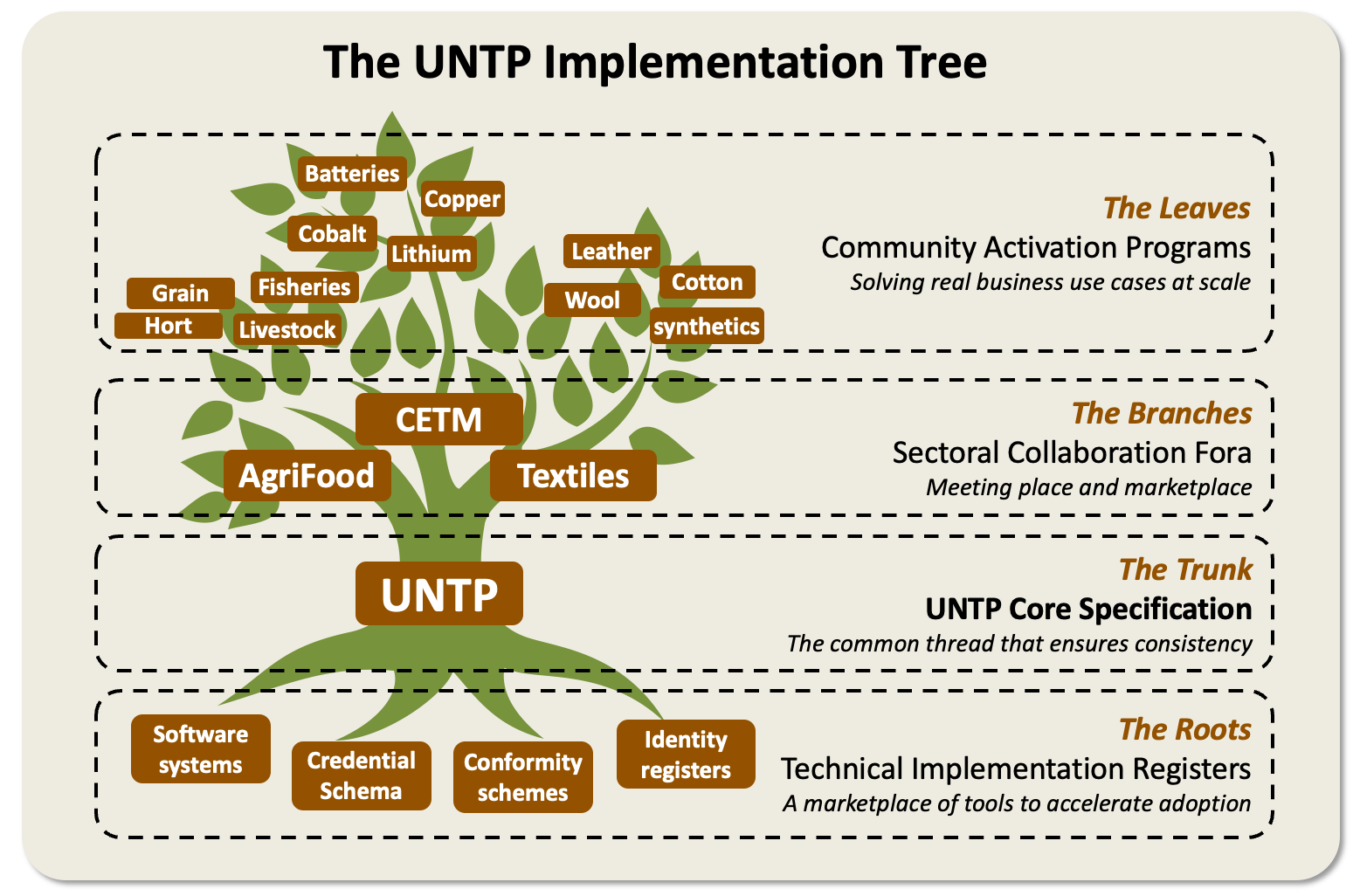
- The trunk is the single UNTP core specification — the universal standard every implementation builds on.
- The branches are sectoral collaboration fora where industries (critical minerals, textiles, agriculture, batteries, …) meet to align and harmonise.
- The leaves are the community implementations — industry associations and brand alliances rolling UNTP out across their members.
- The roots are these registers. They feed the rest of the tree with the trusted, tested components every leaf draws on.
A community that has to commission its own software, define its own conformity vocabulary, build its own identifier resolver, and write a brand-new credential extension before it can issue a single Verifiable Credential is a community that won't activate. The registers exist so activation can begin with selection rather than construction. Pick what fits your needs from the catalogue, and ship. Or, if a community member does not find their preferred software tool or identity or conformity scheme in the registers, they can refer them to these pages.
The four registers, in plain English
| Register | What it catalogues | What it answers for you |
|---|---|---|
| Software Implementers | Platforms that issue and verify UNTP credentials on behalf of brands, producers, and certifiers. | "Which software vendors can my members use, and is their software actually working as expected?" |
| Credential Extensions | Industry-specific or jurisdiction-specific credential types that extend UNTP core (battery passport, livestock passport, electrical goods passport, etc.). | "Has someone already defined a credential format for my sector, or do I need to lead one?" |
| Conformity Schemes | Audit, certification, and assessment programmes whose criteria are referenced by UNTP credentials (RBA VAP, RMAP, GBA Battery Passport Rulebook, The Copper Mark, etc.). | "What standards and frameworks are available to back the sustainability claims my members will make?" |
| Identifier Schemes | Identifier services for products, facilities, organisations, members, and key assets (GS1 GTIN, Open Supply Hub, RBA Member ID, etc.). | "Which identifier system should we use for products / facilities / members, and how do verifiers look them up?" |
A community planning to roll out UNTP can browse all four, pick the components that fit their use case, and trust that each has been independently verified — without doing the verification work themselves.
Why this is faster and cheaper than building from scratch
A typical industry-association deployment of UNTP needs answers to four questions:
- What software will my members use to issue credentials? → look in the software implementer register. If your favourite software is listed then you can confidently use it. If not then ask them to implement.
- Does my industry's credential format already exist? → look in credential extensions register. If you find a match, adopt it. If no, create one and make it available to others.
- What conformity schemes back the claims my members make? → look in conformity schemes register. If your scheme is listed then you can confidently reference the criterion in your issued credentials. If not then ask them to publish and register a conformity vocabulary.
- What identifier schemes do we use for products, facilities, and members? → look in identifier schemes register. If the identifier scheme you use is listed then you can link your credentials to those identifiers. If not then ask them to implement and register.
Without the registers, every community does this research independently — different communities arrive at different answers, validation is inconsistent, and integration is painful. With the registers, every community draws from the same trusted catalogue. Activation moves from research to selection, and from months of vendor due diligence to a few days of choosing what fits.
How the registers stay trustworthy
A traditional industry register is a curated list. Someone fills in a form, the registrar reviews it, the entry goes up. Updates need new submissions. Conformance is asserted by the implementer and accepted on faith.
The UNTP registers work differently. Once an implementer is registered, most of the population and verification of registry details is done automatically by the UNTP validation observer. The implementer's job is to publish a cryptographic identity, sign a registration credential, and expose their service or vocabulary at a stable URL. From that point, the observer system does the work:
- It crawls the registered services on every observation cycle.
- It verifies the published credentials, schemas, and vocabularies are well-formed and signed correctly.
- It compares what it sees today to what was registered, detecting silent drift.
- It writes a signed conformance observation back to the register.
What this means in practice for your community:
- Continuous, independent assurance. Your status reflects observed reality, not asserted intent. If a registered software platform starts shipping non-conformant credentials, the next cycle catches it — your community doesn't have to chase the vendor for a re-test.
- No bottleneck on updates. Registered parties update on their own schedule; the agent picks up changes automatically. The registrar's role is to operate the agent and mediate disputes, not to manually review every change.
- Cryptographic auditability. Every observation is itself a signed credential, so the audit trail is tamper-evident — no party (including UNECE) can quietly modify history.
This is critical at the scale UNTP is designed for, where millions of independent implementers are expected. Self-attestation does not scale to that many participants — there is no way to manually audit a million conformance claims. Continuous, automated, signed observation by a trusted agent is the only mechanism that gives buyers, regulators, and consumers confidence at scale.
The trust chain
When you encounter a UNTP credential about a product or facility — say, a sustainability claim made by a manufacturer using software from vendor X under scheme Y — you can chase the chain of trust all the way back:
- The credential's content is verifiable against the conformity scheme it references and the register confirms the scheme is duly registered and observed.
- The software that issued it is identifiable from a block embedded in every credential and the register confirms the software vendor is duly registered, with continuous observation of conformance.
- The identifiers it carries (product, facility, member, etc.) are resolvable to authoritative information and the register confirms the identifier scheme operator is duly registered, with a UN-issued identity anchor at the top of the chain.
- If the credential is of an industry-specific type (battery passport, livestock passport, …) the register confirms the extension is duly registered with continuously-verified schemas and vocabularies.
The result is a public-good catalogue of trusted, tested UNTP infrastructure that every community activation can draw on. Strong roots, growing tree.
How to engage
| If you are… | Start here |
|---|---|
| A member organisation considering a UNTP rollout for your industry | Read about the Community Activation Program, then browse the four registers to see what already exists for your sector. |
| A software vendor wanting to be listed | How to register your software. |
| An industry body planning a sector-specific extension | How to register an extension. |
| A conformity scheme owner wanting your scheme indexed | How to register a conformity scheme. |
| An identifier scheme operator wanting your scheme indexed | How to register an identifier scheme. |
| Curious about the architecture behind the four registers | The governance documents per register: SWI · EXT · CVC · IDR. |