About the UNTP
Please note that this specification is suitable for pre-production pilot implementations.
Informative
The United Nations Transparency Protocol (UNTP)
UNTP provides a solution to the transparency challenges facing the world's supply chains. By implementing a simple protocol that can be supported by existing business systems, stakeholders will realise immediate benefits and will become visible contributors to the sustainability of global supply chains.
Crucially, UNTP is a protocol, not a platform. The UNTP focuses on interoperability standards that allow any technology platform to participate in interoperable and sustainable value chains. The UNTP defines an architecture comprising standards for product data, facility data, traceability data, conformity data, and identity data.
Each supply chain actor can independently implement UNTP without imposing technical dependencies on any other upstream or downstream actor. In this way, the traceability and transparency information describing arbitrarily complex value chains can "emerge" in a bottom-up manner, like pixels illuminating one by one on a TV screen. Additonally, the UNTP includes security and confidentiality tools that allow each actor to choose their own balance between confidentiality and transparency.
The diagram below provides a conceptual model for the scope of UNTP and the value chain picture that it can reveal.
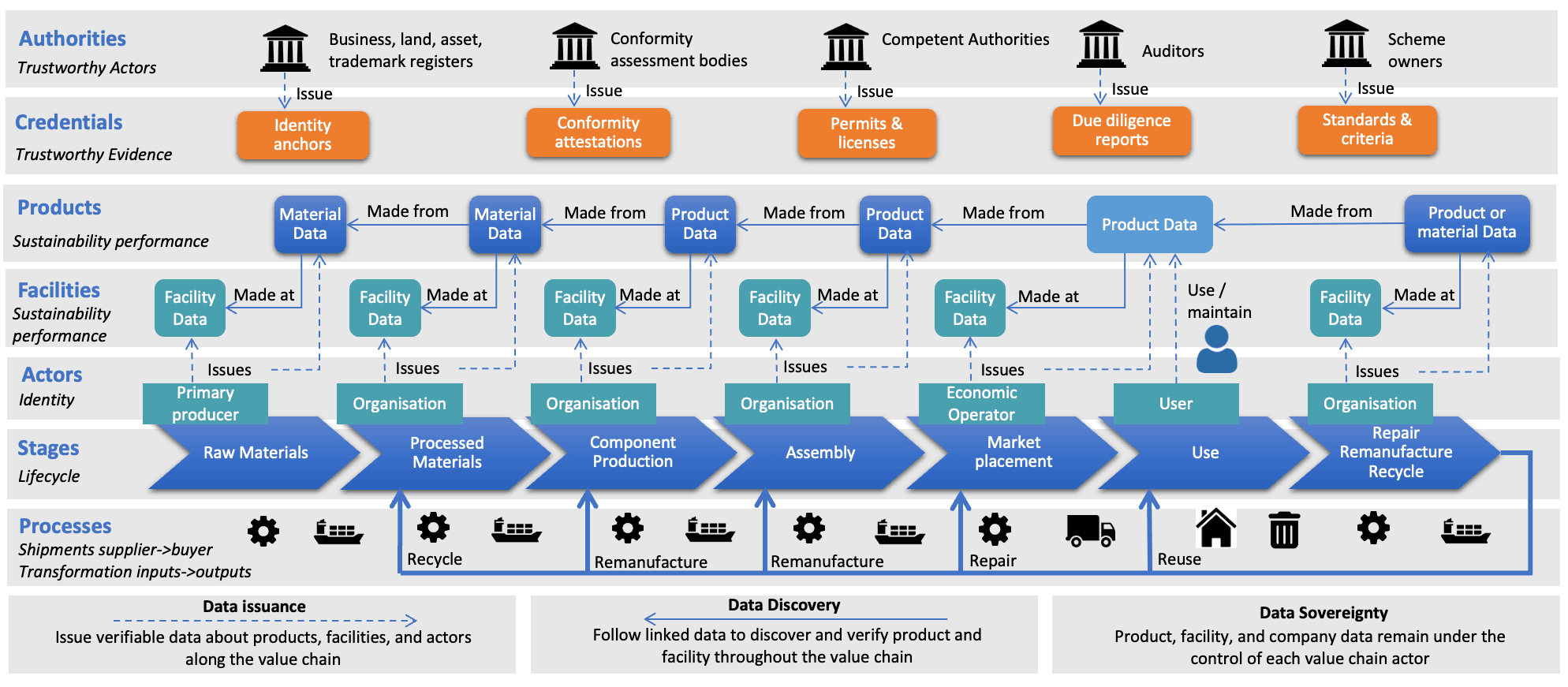
UN/CEFACT Recommendation 49
Recommendation 49: Transparency at Scale – Fostering Sustainable Value Chains was developed in response to an increasing demand for policy action to leverage and enhance the trust in sustainability information. Its development was motivated by the practical challenges2 that United Nations (UN) Member States face in advancing implementation of the Sustainable Development Goal (SDG) 12 of the UN 2030 Agenda for ensuring sustainable consumption and production patterns through traceability in value chains.
In July 2025, The UN/CEFACT Plenary Member States adopted Recommendation No. 49: Transparency at Scale – Fostering Sustainable Value Chains.
The UNTP is the practical application of Recommendation 49.
Watch a 6 minute overview of UNTP:
Incentives for sustainable supply chains are on the rise
Incentives for sustainable supply chains continue to increase.
- Regulations such as the European Regulation on Deforestation (EUDR) and Carbon Border Adjustment Mechanism (CBAM) will present market access barriers or increased border tariffs for non-sustainable produce.
- These regulations impose due diligence obligations on entire supply chains, not just final products. Penalties for repeated non-compliance can be as high as 4% of global revenue.
- Financial institutions are rapidly moving to ensure that capital is preferentially focussed on ESG assets. According to Bloomberg, within a few years, around $50 Trillion or one third of all global assets under management will be ESG assets.
- Consumer sentiment is driving purchasing decisions to favour sustainable products. At the same time, consumers are increasingly mistrustful of unverifiable claims and look for third party certification based on trusted standards.
Challenges
The world's supply chains must reach to the point where digitally verifiable traceability and transparency information is available to meet regulatory compliance, satisfy investors, and motivate consumers for the majority of products on the market. However, achieving transparency at that scale presents some challenges.
-
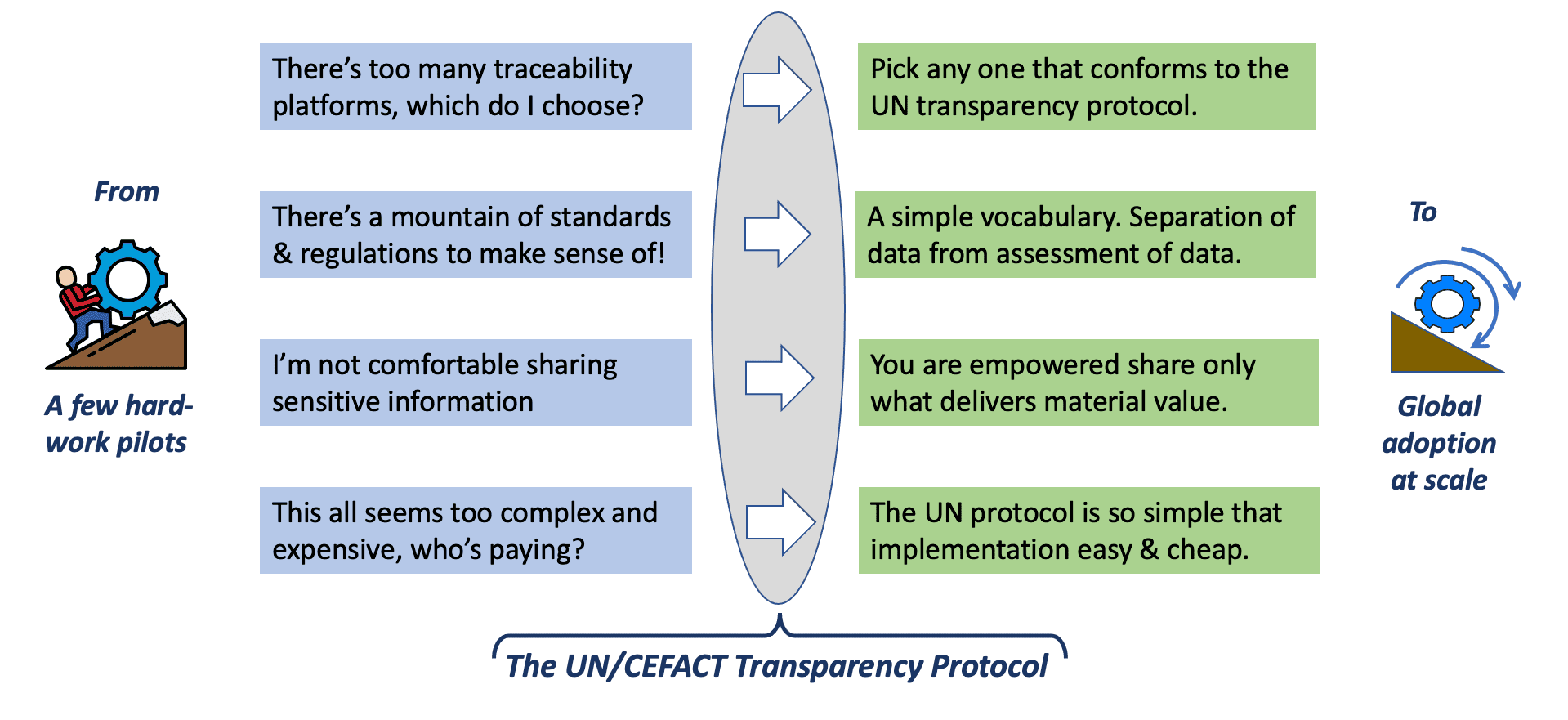
Which software to choose? There are many traceability & transparency solutions on the marketplace. Many expect all actors in a given value chain to subscribe to the same platform in order to collect the data for end-to-end traceability. However, just as expecting your customers and suppliers to create accounts at your bank so that you can pay them is not rational or practical (that's why inter-bank payment standards exist), so the adoption of all actors in value chains to one platform is also not feasible or scalable. As the UNTP is a protocol standard, not a platform, it assumes that supply chain data remains with each natural owner. So the answer to "which software to choose?" is "Pick any, so long as it conforms to the UNTP".
-
Coping with a growing mountain of ESG standards and regulations. The number of ESG standards and regulations worldwide currently exceeds 1,000. These standards and regulations are specific to particular commodities, jurisdictions, or ESG criteria and some cover multiple dimensions. There is a significant overlap between them but very little formal mutual recognition. The consequence is that it becomes very challenging for supply chain actors that sell to multiple export markets to know which criteria matter and how to demonstrate compliance. The UNTP does not add to the complexity by defining more ESG standards. Rather it seeks to minimise cost of compliance by making it simpler to test on-site ESG processes and data against multiple ESG criteria. Essentially this is about implementing a sustainable practice once and then re-using it to satisfy multiple overlapping criteria.
-
Protecting confidential information. "Sunlight is the best auditor" and so verifiable transparency is the best greenwashing counter-measure. However, increased supply chain transparency for ESG purposes also risks exposure of commercially sensitive information. A viable transparency protocol must allow supply chain actors to share ESG evidence whilst protecting sensitive information. Rather than dictate what must be shared and what should not, the UNTP includes a suite of confidentiality measures that allow every supply chain actor to choose their own balance between confidentiality and transparency. The basic principle is that actors should be empowered to share only what delivers value.
-
Making a business case for implementation. Each supply chain actor (or their software provider) will need to make a viable business case for implementation of the UNTP. The transparency incentives discussed in this section represent the benefit side of the equation. To keep the cost side as low as practical, UNTP has a strong "keep it simple" focus and offers a suite of implementation tools to further reduce cost. Some sample business case templates are provided to help actors make their case for action.
Presentations & Videos
| Title | Duration | Description | Presentation | Video |
|---|---|---|---|---|
| Business Overview | 5:45 min | UNTP Overview for non-technical consumers - the problem of scalable automated supply chain compliance assessment and how UNTP solves it | PPT | Youtube |
| Technical Overview | UNTP overview for technical consumers - the UNTP architecture and technical specifications. | coming soon | coming soon |