Please note that this specification is suitable for pre-production pilot implementations.
Community Activation Program
Introduction
The Community Activation Program (CAP) is a member-organisation-led UNTP implementation programme that drives collective adoption across an industry membership. Rather than each organisation implementing independently, a CAP coordinates implementation at community level — achieving efficiency by re-using the four registered technical roots (the SWI register of software vendors, the EXT register of credential extensions, the CVC register of conformity schemes, and the IDR register of identifier schemes), and achieving consistency by collaborating through the relevant sectoral fora.
Each of the four registers is continuously maintained by the UNTP registrar agent, which crawls every registered implementation on every observation cycle and publishes signed conformance results. A community choosing components from these registers therefore inherits cryptographically-verified continuous conformity assurance — no separate vendor or scheme due diligence is required for entries listed as conformant.
Through CAP, member organisations can assess the value of UNTP adoption for their sector, engage diverse stakeholders, and deliver a coordinated implementation that reduces costs and improves interoperability for all participants.
Launching a UNTP project requires careful consideration of specific foundational elements that ensure the project’s alignment with industry needs and its potential for widespread adoption. These include:
-
Catalyst for adoption: Identifying a clear and compelling driver for the project, such as new regulatory requirements (e.g., ESPR or Carbon Border Adjustment Mechanism), or the need to align with a national or sectoral traceability strategy, provides stakeholders with focus and sense of urgency.
-
Engaged buyers: Buyers must perceive significant value in supplier data, such as enhanced product quality, compliance assurance, or risk mitigation. This engagement is essential to drive demand for the project outcomes.
-
Committed suppliers: Suppliers must be willing and able to share critical data with buyers, especially when the project demonstrates a direct benefit to them, such as cost reductions, increased market access, or reputational gains.
-
Funding mechanism: Robust and sustainable funding is crucial for supporting the project’s initial phases, covering development, outreach, and pilot testing. This ensures that the project gains traction and delivers early successes to build momentum.
CAP delivers value to industries and creates a flywheel of adoption
Member organisations leading a CAP deliver significant value to their membership:
- Reduced costs and risks — members share implementation costs and re-use registered software systems, identity registers, and conformity schemes rather than sourcing independently.
- Interoperable implementations — choosing from registered technical components and collaborating through sectoral fora ensures that member implementations are consistent and interoperable.
- Increased membership value — the CAP gives member organisations a compelling new reason for industries to join and stay engaged.
- Accelerated adoption — coordinated community action attracts funding from governments and development banks, and builds momentum as early successes demonstrate value.
- Access to global expertise — CAP communities connect with UNECE guidance, established extension programmes, and a growing network of practitioners.
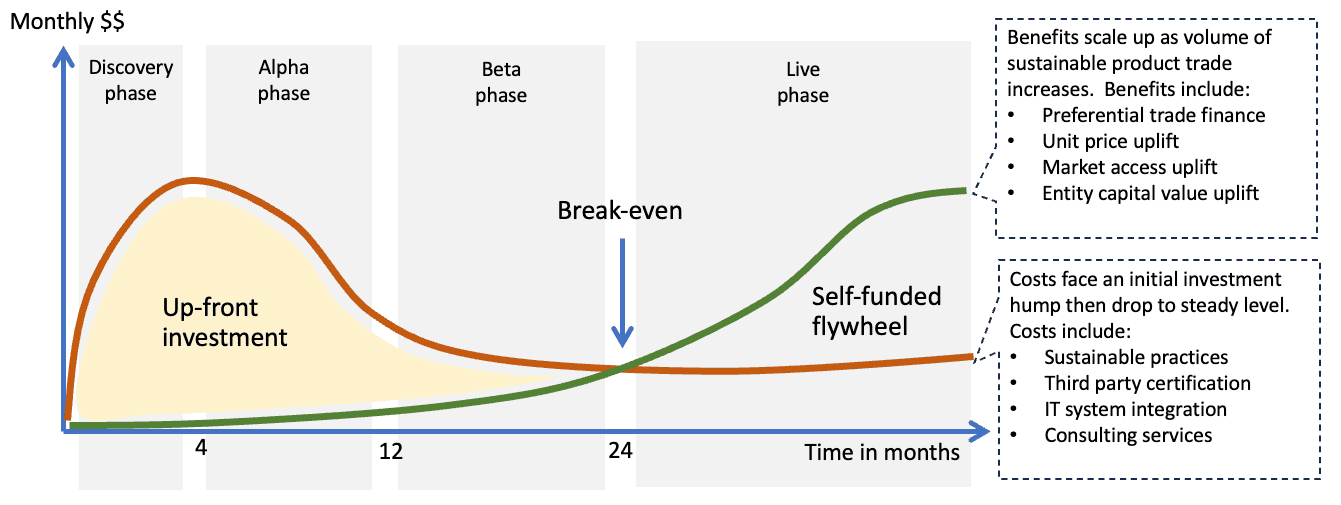
As community implementations mature, they generate a self-sustaining flywheel — each new participant adds value for existing members, attracting further adoption.
CAP supports a structured approach to implementation and adoption
The CAP toolkit offers a proven, phased methodology:
Inception Phase: This initial phase is centered on identifying key catalysts for change, such as emerging regulations, national traceability strategies, or industry-specific challenges. Stakeholders work collaboratively to build consensus, define project goals, and create a compelling business case that articulates value.
Discovery Phase: In this exploratory phase, current practices are systematically mapped to identify strengths, gaps, and opportunities, and the four UNTP registers are searched for existing components that match the community's needs — software in SWI, credential extensions in EXT, conformity schemes in CVC, identifier schemes in IDR. Most communities find that the majority of their technical stack already exists and is continuously verified by the registrar agent; the activation work focuses on the remainder (typically a member-specific identifier scheme to be registered in IDR, and possibly a sector-specific extension to be registered in EXT). Stakeholders prioritize areas for improvement and establish clear objectives that align with industry needs and regulatory demands.
Alpha Phase: During the alpha phase, prototypes of the proposed systems and frameworks are developed and tested within controlled environments. This stage allows stakeholders to assess functionality, refine tools, and demonstrate tangible value to participants. Feedback loops are critical in ensuring the solution is robust and addresses real-world challenges effectively.
Beta Phase: Building on the alpha phase, the beta phase scales the project to a broader set of participants. Emphasis is placed on resolving interoperability challenges, ensuring compatibility with existing systems, and refining operational workflows. The project is tested in live scenarios to validate its scalability and effectiveness.
Live Phase: The final phase transitions the project into full-scale implementation. Stakeholders work to achieve widespread adoption, leveraging continuous improvement mechanisms to adapt to evolving industry needs. This phase ensures the extension remains sustainable, impactful, and aligned with broader industry objectives.
A successful CAP is a team effort
Community-wide UNTP implementation thrives through collaboration with a wide range of stakeholders.
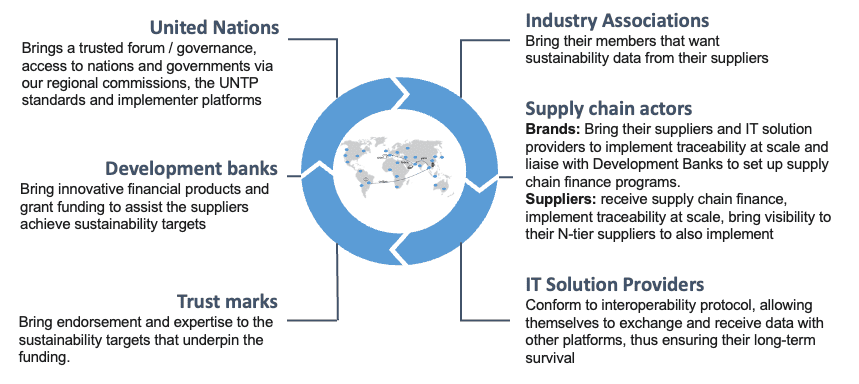
CAP stakeholders bring unique needs and derive tailored benefits:
-
Member organisations: Lead the CAP, coordinating implementation across their membership, selecting registered technical components, and representing the community in relevant sectoral fora.
-
Suppliers: Contribute essential data that ensures compliance with ESG standards and enables access to broader markets. Their participation demonstrates alignment with global sustainability efforts and supports trust across supply chains.
-
Buyers: Play a pivotal role by demanding traceability and guiding the adoption of data standards. This ensures reliable and transparent information flow, bolstering brand trust and improving consumer confidence.
-
Conformity Schemes: Provide critical policy frameworks and credentials that establish the credibility of sustainability efforts. CAP-relevant schemes are sourced from the CVC register, where each entry is continuously verified by the registrar agent for vocabulary conformance, topic classification, and standard/regulatory alignment. They ensure alignment with environmental, social, and governance (ESG) goals and offer a foundation for industry-wide adoption.
-
Development banks: Facilitate sustainable growth by offering ESG-linked financing and investment mechanisms. These institutions provide crucial resources that reduce financial barriers and encourage broader participation in UNTP extension projects.
-
Software systems: Deliver platforms whose UNTP credential issuance is continuously verified by the registrar agent. SWI register listings carry observed conformance results — the community can trust the listing without separate vendor due diligence, enabling scalable and interoperable solutions across the membership.
Expert support
Member organisations bring deep industry knowledge, but CAP teams may benefit from engaging expert consultants with skills in some or all of the following areas:
- Project management — coordinating activities, resources, and milestones across the community.
- IT systems and integration — deploying tools for data exchange, conformance testing, and process automation.
- Trust architecture — designing credential frameworks, data integrity mechanisms, and accountability processes.
- ESG standards — aligning implementations with sustainability frameworks and compliance requirements.
- Stakeholder engagement — building consensus and managing diverse interests across the community.
- UNTP expertise — navigating the specification, extension methodology, and interoperability requirements.
CAP provides access to valuable resources
Communities running a CAP can access a wide range of resources:
-
Frameworks and toolkits: Business case templates, implementation plans, and traceability frameworks provide a foundation for project planning, helping teams map out goals, resource requirements, and value propositions.
-
Registered technical components: The UNTP implementation registers provide a catalogue of tested identity registers, conformity schemes, credential extensions, and software systems that communities can choose from to accelerate implementation.
-
Sectoral fora: The UNTP sectoral fora provide a venue for communities in the same sector or jurisdiction to collaborate on harmonisation, share lessons, and align their implementations.
-
UNECE guidance: Strategic guidance from UNECE ensures that community implementations remain consistent with the core specification and interoperable across borders and industries.
-
Collaboration networks: Engaging with established CAP communities offers opportunities for shared learning, proven methodologies, and alignment with broader industry goals.
Starting a CAP is simple
-
Join the community: Join the general UNTP chat channel via the link on the homepage and join a relevant sectoral fora to collaborate with peers and register your community.
-
Access the CAP toolkit: Access implementation guidance including methodologies, templates, and tools to guide your community through every phase of implementation. For each technical decision (software platform, credential extension, conformity scheme, identifier scheme), browse the corresponding register, pick the components that fit, and proceed. Each register entry's status reflects continuous agent-verified conformance — no further vendor due diligence is required for
conformantentries.