Digital Traceability Events
Please note that this specification is suitable for pre-production pilot implementations.
A Digital Traceability Event may be implemented in either of two equivalent ways:
- UNTP-native — using the
MakeEvent,MoveEvent, andModifyEventschemas defined in this specification. - EPCIS Profile — using GS1 EPCIS 2.0 events that conform to the constrained profile in EPCIS Profile below.
Both paths express the same supply chain semantics, are issued as W3C Verifiable Credentials, and interoperate with the rest of the UNTP credential suite. Implementers without existing EPCIS infrastructure should adopt the UNTP-native schemas; implementers operating an EPCIS 2.0 capture/query interface should follow the EPCIS Profile.
Artifacts
V0.7.0 Schema and Samples
The JSON schema and sample credential instances for Digital Traceability Events are maintained in this repository.
- JSON Schema:
| Schema | Description |
|---|---|
| DigitalTraceabilityEvent.json | Full credential schema including the W3C VC envelope and event subjects |
| MakeEvent.json | Schema for manufacturing events (input products consumed to create output products) |
| ModifyEvent.json | Schema for modification events (test, repair, repurpose, or consume a product) |
| MoveEvent.json | Schema for movement events (ship products between facilities) |
- Sample Instances:
| Sample | Description |
|---|---|
| DigitalTraceabilityEvent_instance.json | Copper concentrate production at a sample mine in Zambia |
| DigitalTraceabilityEvent_smelter_make_instance.json | Copper cathode smelting at a sample refinery in Japan |
| DigitalTraceabilityEvent_cathode_move_instance.json | Copper cathode shipment from refinery to battery factory |
| DigitalTraceabilityEvent_battery_make_instance.json | Battery pack assembly at a sample factory in Germany |
The samples trace the copper-to-battery supply chain through make and move events.
Vocabulary and Context
The DTE is built on the UNTP Core Vocabulary, which defines the shared classes and properties used across all UNTP credential types. The machine-readable vocabulary and JSON-LD context files are published at https://vocabulary.uncefact.org/untp/.
Sample Credential
| URL | QR | Description |
|---|---|---|
| Sample Digital Traceability Event |  | A sample digital traceability event as a signed Verifiable Credential. The URL (or QR scan) resolves to a hosted verifier that displays a human-readable version. Raw JSON data can be viewed via the JSON tab and the full credential can be downloaded via the download button. |
Overview
Digital Traceability Events (DTEs) are lightweight verifiable credentials that record the “what, when, where, who, and how” of product lifecycle activities across a value chain. Any supply chain, regardless of complexity, can be accurately modelled using a combination of three event types. A make event records a manufacturing or processing step that consumes input products to create output products at a facility. A move event records the shipment of products from one facility to another. A modify event records a post-market action on an existing product such as inspection, repair, refurbishment, or recycling. Together, make and move events model the stocks and flows through each facility, enabling facility-level mass-balance assessment of sustainability claims. Each DTE is issued as a W3C Verifiable Credential so that it can be independently verified and linked to other credentials such as Digital Product Passports and Digital Conformity Credentials. DTEs are discoverable from identity resolvers using the product identifier, subject to access control where commercially sensitive data needs protection.
Conceptual Model
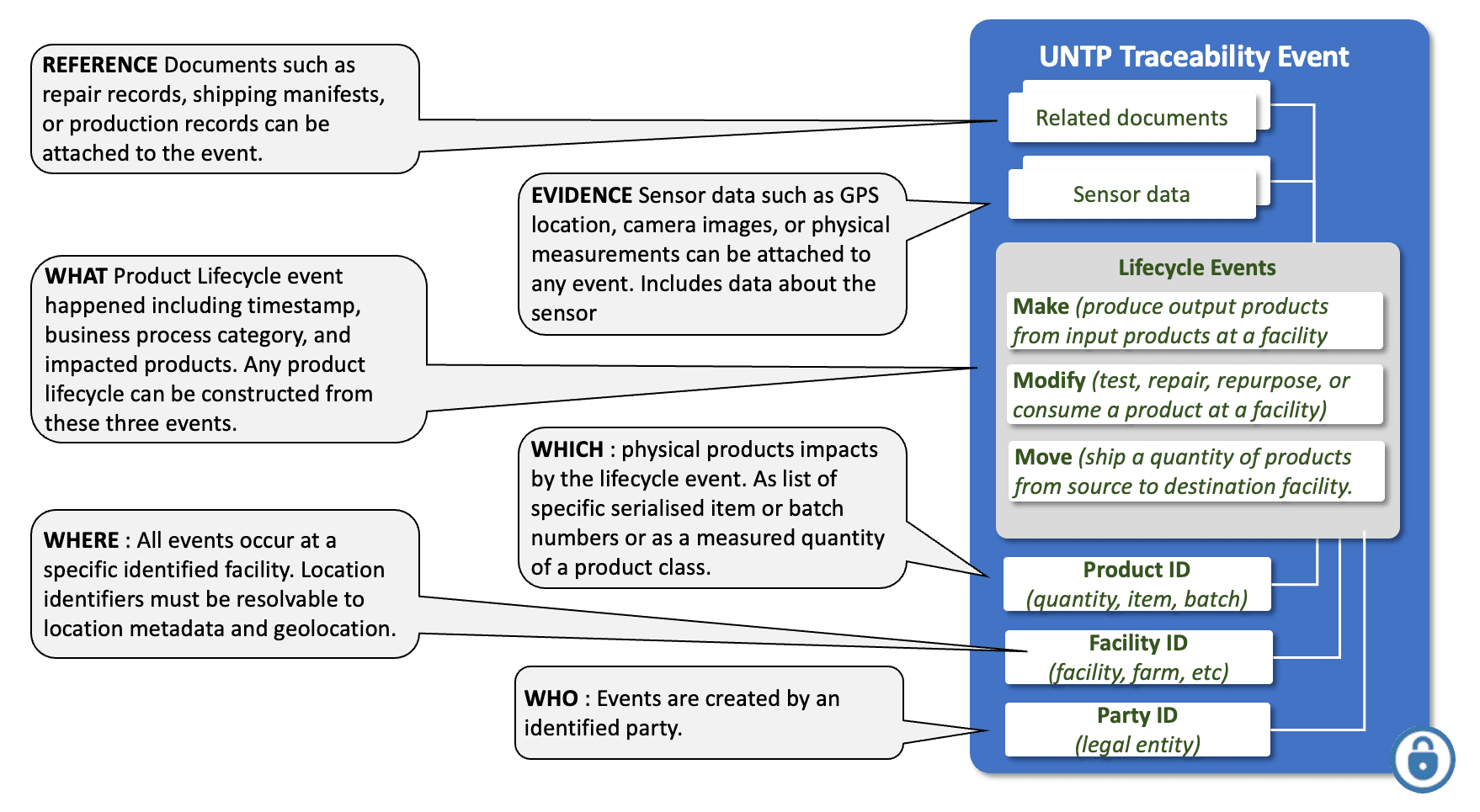
The conceptual model answers six key questions about every lifecycle event:
- WHAT — what product lifecycle event happened, including a timestamp and business process category. Any product lifecycle can be constructed from three event types: Make (produce output products from input products at a facility), Modify (test, repair, repurpose, or consume a product at a facility), and Move (ship a quantity of products from source to destination facility).
- WHICH — which physical products are impacted by the event, expressed as a list of specific serialised item or batch identifiers, or as a measured quantity of a product class.
- WHERE — all events occur at a specific identified facility whose location identifiers must be resolvable to location metadata and geolocation.
- WHO — events are created by an identified party, establishing accountability for the recorded information.
- EVIDENCE — sensor data such as GPS location, camera images, or physical measurements can be attached to any event, including metadata about the sensor device itself.
- REFERENCE — supporting documents such as repair records, shipping manifests, or production records can be attached to the event.
Requirements
The traceability event is designed to meet the following detailed requirements as well as the more general UNTP Requirements
| ID | Name | Requirement Statement | Solution Mapping |
|---|---|---|---|
| TEV-01 | Sub-components | The traceability event MUST provide a mechanism to trace from a DPP representing a product assembly to the individual DPPs of each sub-assembly component part. | MakeEvent — component parts are inputProduct items, the assembled product is the outputProduct. |
| TEV-02 | Consumed materials | The traceability event MUST provide a mechanism to trace a manufactured product DPP back to the DPPs representing batches of input materials that are consumed in manufacturing one or more output products. | MakeEvent — inputProduct and outputProduct arrays with product identifiers and quantities. |
| TEV-03 | Aggregated bundles | When a DPP represents an aggregated bundle of similar items (e.g. a pallet of cotton bales) then the traceability event MUST provide a means to allocate the aggregate measures to each individual item (i.e. each bale). | MakeEvent — individual items are inputProduct entries, the aggregated bundle is the outputProduct (or vice versa for disaggregation). |
| TEV-04 | Transportation | When a product (or consolidated consignment) is shipped from one physical location to another, the traceability event MUST provide a means to record the movement and associate sustainability measures such as transport emissions to the shipped bundle. | MoveEvent — movedProduct, fromFacility, toFacility, and consignmentId. Sensor data can capture transport emissions. |
| TEV-05 | Items or quantities | Traceability events MUST work equally well whether the input or output items are individually serialised items or measured quantities (mass or volume) of a product class. | EventProduct — product.idGranularity distinguishes item, batch, and model level identification; quantity provides the measured amount. |
| TEV-06 | IoT sensor data | Traceability events will often be generated by or associated with physical sensor readings. In such cases, the traceability event SHOULD support the association of sensor data with the event. | SensorData — sensorData array on LifecycleEvent with metric, measure, sensor device, and geo-location. |
| TEV-07 | Time and location | Traceability events MUST always record the timestamp and physical location of the event so that multiple events can be connected in time and space. | LifecycleEvent — eventDate timestamp; facility references (madeAtFacility, fromFacility/toFacility, modifiedAtFacility) provide location. |
| TEV-08 | Product disposition | The traceability event MUST record the state of each product after the event has occurred (e.g. new, consumed, repaired, recycled, disposed) so that product status can be tracked through its lifecycle. | EventProduct — disposition property using the productStatus code list. |
| TEV-09 | Activity classification | The traceability event MUST support industry-specific classification of the business activity (e.g. ginning, spinning, weaving in textiles) so that generic event types can carry domain-specific context. | LifecycleEvent — activityType as a Classification drawn from a recognised scheme such as the GS1 CBV Business Step vocabulary. |
| TEV-10 | Related documents | The traceability event SHOULD support links to related credentials and documents such as Digital Product Passports, Digital Conformity Credentials, test results, or shipping manifests. | Related Documents — relatedDocument array of Link entries with URL, name, media type, and link type. |
| TEV-11 | Related parties | The traceability event MUST identify the parties involved in the event and their roles (e.g. manufacturer, shipper, receiver) to establish accountability. | Related Parties — relatedParty array of PartyRole entries with role and party identification. |
| TEV-12 | Confidentiality | The traceability event SHOULD support access control mechanisms so that commercially sensitive data (particularly input supply sources in make events) can be selectively shared. | Decentralised Access Control — credentials may be access-restricted using decentralised access control patterns. |
| TEV-13 | Mass-balance support | The traceability event model MUST support facility-level mass-balance accounting so that a facility's claimed outputs can be verified against its documented inputs and inventory. | MakeEvent and MoveEvent — together they model stocks and flows through a facility as described in the Chain of Custody design pattern. |
Logical Model
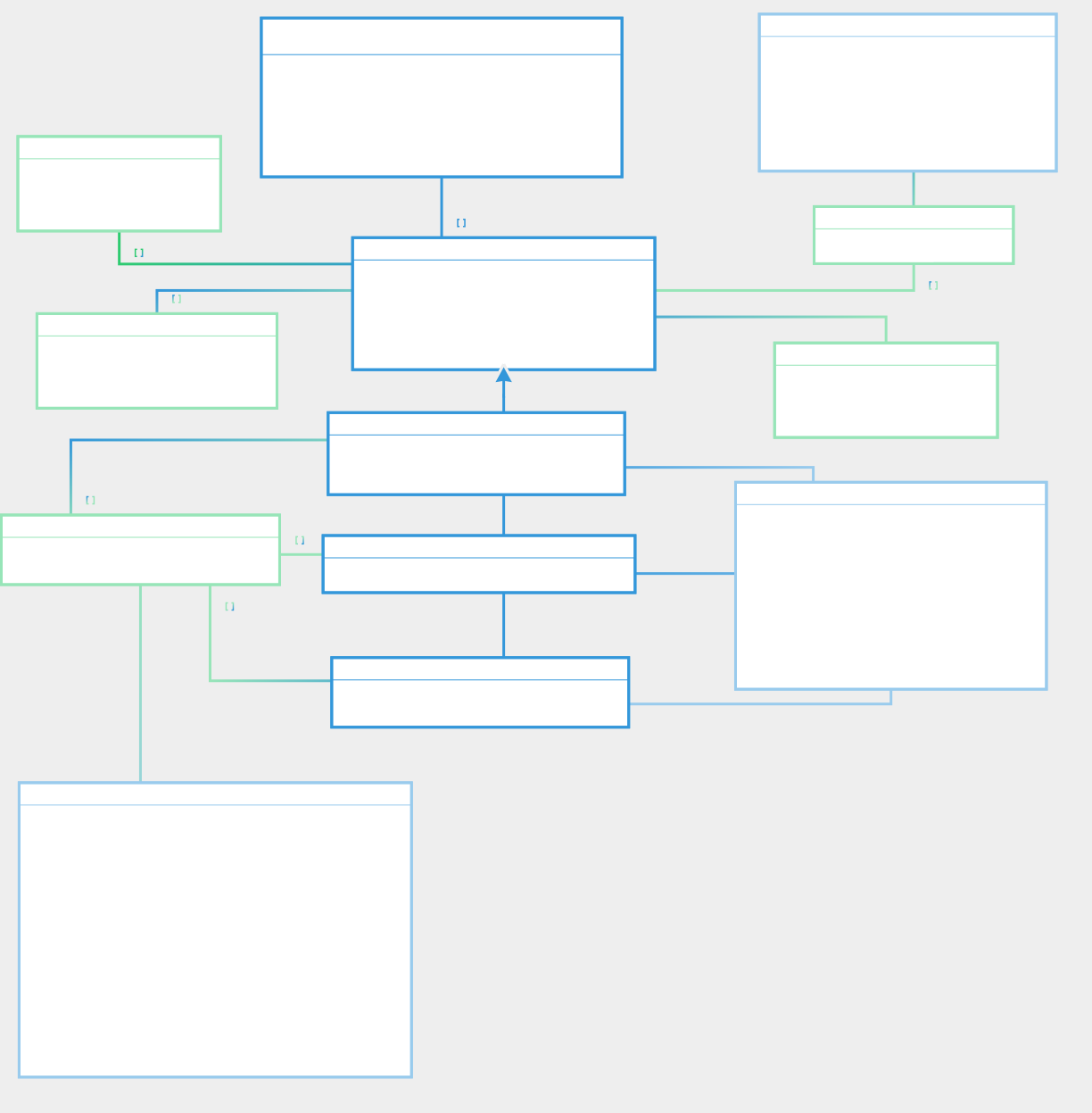
The DigitalTraceabilityEvent is a W3C Verifiable Credential whose credentialSubject contains one or more LifecycleEvent instances. The abstract LifecycleEvent base class defines the common properties shared by all event types: an identifier, event date, activity type classification, related parties, sensor data, and related documents. Three concrete event types extend LifecycleEvent:
- MakeEvent — represents a manufacturing or processing step that consumes
inputProductitems to createoutputProductitems at amadeAtFacility. This is the most important event type for supply chain traceability because it links output product DPPs back to their input material DPPs. - MoveEvent — represents the shipment of
movedProductitems from afromFacilityto atoFacility, optionally referencing aconsignmentId. Move events connect the physical locations along a supply chain. - ModifyEvent — represents an action on a
modifiedProductat amodifiedAtFacility, such as testing, repair, repurposing, or consumption.
Each event references products via EventProduct (linking a Product with an optional quantity and disposition), facilities via Facility, and parties via PartyRole. IoT sensor readings are captured as SensorData and supporting documents as Link. Activity types are classified using Classification.
Implementation Guidance
Simplified Event Model
The UNTP make, move, and modify lifecycle events are a deliberately simplified set of event types intended to be sufficient for product lifecycle needs across any industry:
- Make and Move events are primarily targeted at facility-level mass-balance assessment as described in the Chain of Custody design pattern. They work by modelling stocks and flows through a facility — make events record inputs consumed and outputs produced, while move events record products entering or leaving a facility. Together, they enable verifiable material accounting: confirming that a facility's claimed outputs are consistent with its documented inputs and inventory.
- Modify events are largely targeted at post-market-entry actions such as repair, refurbishment, observation, testing, and recycling — actions that change a product's state but retain its identity.
Activity Type Classification
The event-level activityType classification is designed to provide industry-specific context to the event. While the UNTP event model is generic (make, move, modify), the activityType drawn from a recognised classification scheme allows implementers to express domain-specific processes. For example, a textile supply chain might use activity types such as ginning, spinning, weaving, and dyeing to distinguish different manufacturing steps, all of which are structurally MakeEvent instances.
Discoverability
Like all UNTP credential types, DTEs are discoverable from link resolvers using the product identifier — subject to confidentiality constraints. When a product's DPP is resolved via its identifier, the associated traceability events can also be discovered, enabling downstream actors to traverse the supply chain graph.
Supporting Evidence
Sensor data and related documents associated with any lifecycle event provide additional information and evidence to support the event. For example, a move event might include GPS tracking data from a transport sensor, or a modify event might link to a test result document. These attachments strengthen the evidentiary basis of the event without changing its core structure.
Confidentiality
The data in lifecycle events — particularly make events, which reveal input supply sources for output products — may be considered commercially sensitive. Implementers may choose to restrict access to these credentials following the Decentralised Access Control guidance, which allows credential holders to grant selective access to specific parties rather than publishing events openly.
The components of a DTE
This section walks through each component of a Digital Traceability Event credential using snippets from the sample instances. The samples trace the copper-to-battery supply chain: copper concentrate is shipped from a mine in Zambia to a refinery in Japan, smelted into copper cathode, shipped to a battery factory in Germany, and assembled into a battery pack.
Credential Envelope
A DTE is issued as a W3C Verifiable Credential. The outer envelope identifies the credential, its issuer, and its validity period. The credentialSubject array contains one or more lifecycle events. This example is from the smelter make event.
{
  "type": ["DigitalTraceabilityEvent", "VerifiableCredential"],
  "@context": [
    "https://www.w3.org/ns/credentials/v2",
    "https://vocabulary.uncefact.org/untp/"
  ],
  "id": "https://credentials.sample-refinery.example.com/dte/make-cathode-2025-0305",
  "issuer": {
    "type": ["CredentialIssuer"],
    "id": "did:web:sample-refinery.example.com",
    "name": "Sample Copper Refinery Co. Ltd",
    "issuerAlsoKnownAs": [...]
  },
  "validFrom": "2025-03-05T00:00:00Z",
  "validUntil": "2026-03-05T00:00:00Z",
  "name": "Smelting of Copper Concentrate into Copper Cathode — Sample",
  "credentialSubject": [...]
}
Please refer to DPP VC Guidance for more detail about the use of the W3C verifiable credentials data model for UNTP.
Lifecycle Event
All three event types extend the abstract LifecycleEvent and share a common set of properties that record what happened, when, and who was involved. This example shows the common properties from the smelter make event.
{
  "type": ["MakeEvent", "LifecycleEvent"],
  "id": "https://sample-refinery.example.com/events/make-cathode-2025-0305",
  "name": "Copper smelting and electrolytic refining batch",
  "description": "Processing of 30 tonnes of copper concentrate ...",
  "eventDate": "2025-03-05T06:00:00Z",
  "activityType": {
    "code": "commissioning",
    "name": "Commissioning",
    "definition": "The process of manufacturing or assembling a product ...",
    "schemeId": "https://ref.gs1.org/cbv/BizStep",
    "schemeName": "GS1 CBV Business Step"
  },
  "relatedParty": [...],
  "relatedDocument": [...]
}
id— a unique URI for this specific event instance.eventDate— the timestamp when the event occurred.activityType— a Classification drawn from a recognised scheme such as the GS1 CBV Business Step vocabulary.relatedParty— the parties involved in the event and their roles (see Related Parties below).relatedDocument— links to supporting credentials or documents (see Related Documents below).
Sensor Data
The optional sensorData array on any lifecycle event captures IoT sensor readings associated with the event — for example temperature during transport, GPS coordinates of a shipment, or camera images at an inspection point. Each SensorData entry identifies the metric being measured, the sensor device, and one or more readings.
"sensorData": [
  {
    "type": ["SensorData"],
    "metric": {
      "id": "https://vocabulary.uncefact.org/untp/metrics#temperature",
      "name": "Ambient Temperature"
    },
    "measure": [
      { "value": 22.5, "unit": "CEL" },
      { "value": 23.1, "unit": "CEL" }
    ],
    "sensor": {
      "id": "https://sensors.sample-refinery.example.com/temp-401",
      "name": "Furnace outlet thermocouple T-401"
    },
    "geoLocation": {
      "latitude": 35.6762,
      "longitude": 139.6503
    }
  }
]
metric— identifies the type of measurement (e.g. temperature, humidity, weight) using a PerformanceMetric reference.measure— one or more Measure values with a numeric value and UN/CEFACT unit code.sensor— the device that captured the reading, identified by URI and name.geoLocation— optional GPS coordinates of the sensor at the time of the reading.rawData— optional links to raw data files such as images or instrument output.
Make Event
A MakeEvent represents a manufacturing or processing step that consumes input products to create output products at a facility. This is the most important event type for supply chain traceability because it links output product DPPs back to their input material DPPs. This example shows the smelting of copper concentrate into copper cathode at the Sample Copper Refinery.
{
  "type": ["MakeEvent", "LifecycleEvent"],
  "id": "https://sample-refinery.example.com/events/make-cathode-2025-0305",
  "eventDate": "2025-03-05T06:00:00Z",
  "inputProduct": [
    {
      "product": {
        "id": "https://id.sample-mine.example.com/product/cu-conc-2025",
        "name": "Copper Concentrate (Cu 30%)",
        "batchNumber": "2025-Q1-4501",
        "idGranularity": "model"
      },
      "quantity": { "value": 30000, "unit": "KGM" },
      "disposition": "consumed"
    }
  ],
  "outputProduct": [
    {
      "product": {
        "id": "https://id.sample-refinery.example.com/product/cu-cathode-2025",
        "name": "LME Grade A Copper Cathode",
        "batchNumber": "2025-Q1-0812",
        "idGranularity": "model"
      },
      "quantity": { "value": 10000, "unit": "KGM" },
      "disposition": "new"
    }
  ],
  "madeAtFacility": {
    "id": "https://facility-register.example.com/fac-002",
    "name": "Sample Copper Refinery",
    "registeredId": "fac-002"
  }
}
inputProduct— the products consumed in this manufacturing step, each as an EventProduct with a product identifier, quantity, and disposition (typicallyconsumed).outputProduct— the products created, with disposition typicallynew.madeAtFacility— the Facility where manufacturing took place.
Move Event
A MoveEvent represents the shipment of products from one facility to another. This example shows the shipment of copper cathode from the refinery in Japan to the battery factory in Germany.
{
  "type": ["MoveEvent", "LifecycleEvent"],
  "id": "https://sample-refinery.example.com/events/move-cathode-2025-0310",
  "eventDate": "2025-03-10T14:00:00Z",
  "movedProduct": [
    {
      "product": {
        "id": "https://id.sample-refinery.example.com/product/cu-cathode-2025",
        "name": "LME Grade A Copper Cathode",
        "batchNumber": "2025-Q1-0812",
        "idGranularity": "model"
      },
      "quantity": { "value": 2000, "unit": "KGM" },
      "disposition": "in_transit"
    }
  ],
  "fromFacility": {
    "id": "https://facility-register.example.com/fac-002",
    "name": "Sample Copper Refinery",
    "registeredId": "fac-002"
  },
  "toFacility": {
    "id": "https://facility-register.example.com/fac-003",
    "name": "Sample Battery Factory",
    "registeredId": "fac-003"
  },
  "consignmentId": "urn:carrier:sea-freight:BL-2025-SG-BG-0310"
}
movedProduct— the products being shipped, with disposition typicallyin_transit.fromFacilityandtoFacility— the origin and destination Facility for the shipment.consignmentId— an optional URI identifying the transport consignment (e.g. a bill of lading number).
Modify Event
A ModifyEvent represents an action performed on a product at a facility — such as testing, repair, repurposing, or consumption — where the product identity is retained but its state changes. The current sample supply chain does not include a modify event, but a typical example would be a quality inspection of a battery pack.
{
  "type": ["ModifyEvent", "LifecycleEvent"],
  "id": "https://sample-battery.example.com/events/inspect-battery-2025-0402",
  "eventDate": "2025-04-02T10:00:00Z",
  "activityType": {
    "code": "inspecting",
    "name": "Inspecting",
    "schemeId": "https://ref.gs1.org/cbv/BizStep",
    "schemeName": "GS1 CBV Business Step"
  },
  "modifiedProduct": [
    {
      "product": {
        "id": "https://id.sample-battery.example.com/product/bat-75kwh-2025",
        "name": "75 kWh Li-ion Battery Pack",
        "itemNumber": "BAT-75-2025-00471",
        "idGranularity": "item"
      },
      "disposition": "active"
    }
  ],
  "modifiedAtFacility": {
    "id": "https://facility-register.example.com/fac-003",
    "name": "Sample Battery Factory",
    "registeredId": "fac-003"
  }
}
modifiedProduct— the products acted upon, with disposition reflecting the outcome (e.g.activeafter a successful inspection).modifiedAtFacility— the Facility where the action took place.
Event Products
Each event references products via the EventProduct structure, which pairs a Product identifier with an optional quantity and a disposition code indicating the product's status. Products can be identified at different levels of granularity — by modelNumber (product class), batchNumber (production batch), or itemNumber (individual serialised item).
{
  "product": {
    "id": "https://id.sample-battery.example.com/product/bat-75kwh-2025",
    "name": "75 kWh Li-ion Battery Pack",
    "modelNumber": "BAT-NMC811-75",
    "batchNumber": "2025-SZG-0342",
    "itemNumber": "BAT-75-2025-00471",
    "idGranularity": "item"
  },
  "quantity": { "value": 450, "unit": "KGM" },
  "disposition": "new"
}
Related Parties
The relatedParty array identifies the parties involved in an event and their roles. Move events typically have shipper and receiver roles; make events typically have a manufacturer role.
"relatedParty": [
  {
    "role": "shipper",
    "party": {
      "type": ["Party"],
      "id": "did:web:sample-refinery.example.com",
      "name": "Sample Copper Refinery Co. Ltd",
      "registeredId": "REF-001",
      "idScheme": {
        "id": "https://www.sample-register.example.com",
        "name": "Japan Corporate Number (Houjin Bangou)"
      }
    }
  },
  {
    "role": "receiver",
    "party": {
      "type": ["Party"],
      "id": "did:web:sample-battery.example.com",
      "name": "Sample Battery Mfg GmbH",
      "registeredId": "BAT-001"
    }
  }
]
Related Documents
The relatedDocument array links the event to supporting credentials or documents. Typical links include the Digital Product Passport for the output product and any relevant Digital Conformity Credentials.
"relatedDocument": [
  {
    "linkURL": "https://credentials.sample-refinery.example.com/dpp/cu-cathode-2025",
    "linkName": "Digital Product Passport — LME Grade A Copper Cathode",
    "mediaType": "application/ld+json",
    "linkType": "https://test.uncefact.org/vocabulary/linkTypes/dpp"
  },
  {
    "linkURL": "https://credentials.sample-cab.example.com/dcc/smelter-002",
    "linkName": "Coppermark Certification — Sample Copper Refinery",
    "mediaType": "application/ld+json",
    "linkType": "https://test.uncefact.org/vocabulary/linkTypes/dcc"
  }
]
EPCIS Profile
GS1 EPCIS 2.0 is a mature, widely deployed standard for capturing supply chain events as JSON-LD. This profile defines the constrained EPCIS usage that satisfies UNTP Digital Traceability Event requirements. Events that conform to this profile carry the same semantics as UNTP-native DTEs and can be wrapped as W3C Verifiable Credentials for inclusion in the UNTP credential graph.
The profile follows established practice in industry traceability programmes that map sector-specific tracking events onto EPCIS event types — extending the GS1 Core Business Vocabulary (CBV) with industry-namespaced bizStep URIs where the standard CBV vocabulary does not cover the activity.
Event Type Mapping
| UNTP Event | EPCIS Event | EPCIS action | Typical bizStep | Typical disposition |
|---|---|---|---|---|
MakeEvent (transformation) | TransformationEvent | — | commissioning, assembling, creating_class_instance | active |
MakeEvent (pure aggregation/disaggregation) | AggregationEvent | ADD / DELETE | packing, unpacking | active, inactive |
MoveEvent | ObjectEvent | OBSERVE | shipping, receiving, arriving, transporting | in_transit |
ModifyEvent | ObjectEvent | OBSERVE (or ADD for repair re-commissioning) | inspecting, repairing, sampling, decommissioning, destroying | conformant, non_conformant, available, damaged, disposed |
bizStep and disposition values are URIs from the CBV (e.g. https://ref.gs1.org/cbv/BizStep-shipping). Industry-specific activities not present in CBV are expressed as extension URIs in a sector namespace (for example urn:gdst:bizstep:fishingEvent in the seafood sector), following the EPCIS extension mechanism. Equivalent UNTP activityType classifications use the same URI as the bizStep so that round-tripping preserves the activity context.
Property Mapping
| UNTP property | EPCIS property | Notes |
|---|---|---|
id | eventID | Unique event URI |
eventDate | eventTime (+ eventTimeZoneOffset) | ISO 8601 timestamp |
activityType | bizStep | CBV URI or sector-specific extension |
inputProduct (Make) | inputEPCList and/or inputQuantityList | Instance vs class-level |
outputProduct (Make) | outputEPCList and/or outputQuantityList | Instance vs class-level |
movedProduct / modifiedProduct | epcList and/or quantityList | Instance vs class-level |
madeAtFacility / modifiedAtFacility | bizLocation | Facility URI |
fromFacility (Move) | readPoint and sourceList[type=SDT-location] | |
toFacility (Move) | destinationList[type=SDT-location] | |
relatedParty[role=shipper] | sourceList[type=SDT-possessing_party] | |
relatedParty[role=receiver] | destinationList[type=SDT-possessing_party] | |
consignmentId (Move) | bizTransactionList[type=BTT-bol] | Bill of lading reference |
relatedDocument | bizTransactionList | DPP and DCC links use BTT-cert; test results BTT-testres; production orders BTT-prodorder |
sensorData | sensorElementList | sensorMetadata for the device, sensorReport[] for measurements with type, value, uom |
disposition (per product) | disposition (per event) | See Disposition Semantics below |
Identifiers
EPCIS requires URI-form identifiers. Two equally valid patterns are supported under this profile:
- GS1 EPC URIs — preferred where the implementer holds GS1 prefixes. Use
sgtinfor serialised items,lgtinfor batches,sglnfor facilities,pglnfor parties. - HTTPS URLs or UUID URNs — for implementers without GS1 prefixes. Any resolvable URL or UUID may serve as the identifier prefix, provided it is globally unique and stable.
| Object | GS1 example | Non-GS1 example |
|---|---|---|
| Serialised item | urn:epc:id:sgtin:0614141.107346.2025001 | https://id.example.com/product/cu-cathode-2025/item/00471 |
| Batch | urn:epc:class:lgtin:0614141.107346.2025-Q1 | https://id.example.com/product/cu-cathode-2025/batch/Q1-0812 |
| Facility | urn:epc:id:sgln:0614141.12345.0 | https://facility-register.example.com/fac-002 |
| Party | urn:epc:id:pgln:0614141.00440.0 | did:web:sample-refinery.example.com |
The two styles MAY be mixed within a single event — for example a non-GS1 product URI alongside a GS1 facility GLN.
Disposition Semantics
UNTP records disposition per EventProduct (using the productStatus code list). EPCIS records disposition once per event (using the CBV Disp-* URIs). The two are reconciled as follows:
- A MakeEvent maps cleanly: input products are implicitly consumed by the EPCIS
TransformationEvent, so only the output disposition is set at the event level. - A MoveEvent typically carries all products in the same
in_transitstate, matching the event-level disposition naturally. - A ModifyEvent whose products carry different dispositions MUST be split into one EPCIS
ObjectEventper disposition.
UNTP productStatus to CBV disposition mapping:
| UNTP | CBV | CBV URI |
|---|---|---|
new | active | https://ref.gs1.org/cbv/Disp-active |
consumed | (implicit in TransformationEvent) | — |
repaired | available | https://ref.gs1.org/cbv/Disp-available |
recycled | active | https://ref.gs1.org/cbv/Disp-active |
disposed | disposed | https://ref.gs1.org/cbv/Disp-disposed |
EPCIS implementers MAY use additional CBV dispositions (conformant, non_conformant, damaged, destroyed, recalled, expired, returned, inactive, container_closed) for finer-grained semantics; when round-tripping to UNTP, map back to the closest productStatus value.
Verifiable Credential Wrapping
UNTP requires every traceability event to be issued as a W3C Verifiable Credential. An EPCIS event is wrapped by placing it as the credentialSubject of a VC envelope. The example below shows the smelter make event expressed as an EPCIS TransformationEvent:
{
  "type": ["DigitalTraceabilityEvent", "VerifiableCredential"],
  "@context": [
    "https://www.w3.org/ns/credentials/v2",
    "https://ref.gs1.org/epcis/"
  ],
  "id": "https://credentials.sample-refinery.example.com/dte/make-cathode-2025-0305",
  "issuer": {
    "id": "did:web:sample-refinery.example.com",
    "name": "Sample Copper Refinery Co. Ltd"
  },
  "validFrom": "2025-03-05T00:00:00Z",
  "credentialSubject": {
    "type": "TransformationEvent",
    "eventTime": "2025-03-05T06:00:00Z",
    "eventTimeZoneOffset": "+09:00",
    "bizStep": "https://ref.gs1.org/cbv/BizStep-commissioning",
    "disposition": "https://ref.gs1.org/cbv/Disp-active",
    "bizLocation": { "id": "https://facility-register.example.com/fac-002" },
    "inputQuantityList": [
      {
        "epcClass": "https://id.sample-mine.example.com/product/cu-conc-2025",
        "quantity": 30000,
        "uom": "KGM"
      }
    ],
    "outputQuantityList": [
      {
        "epcClass": "https://id.sample-refinery.example.com/product/cu-cathode-2025",
        "quantity": 10000,
        "uom": "KGM"
      }
    ],
    "bizTransactionList": [
      {
        "type": "https://ref.gs1.org/cbv/BTT-cert",
        "bizTransaction": "https://credentials.sample-refinery.example.com/dpp/cu-cathode-2025"
      }
    ]
  }
}
Both this credential and the equivalent UNTP-native make event reference the same product, facility, and linked DPP identifiers, and convey the same supply chain semantics.